
Your Nervous System Knows
When You’re Not Safe in the Conversation… And What Real Attunement Feels Like


Have you ever shared something… only to be met with a fix, a correction, a reframing, or a dismissal?
Maybe you clenched a little. You weren’t overreacting.
Your body clocks the dynamic instantly. The power play. The hidden tilt there. From a colleague or a coach, a family member or someone new you’re dating.
In cultures still wired for hierarchy, relational presence feels rare.
But it isn’t a luxury. It’s a biological need. One we sense before we speak.
Your nervous system always knows. Maybe it’s time to believe your nervous system.
What Is Relational Presence?
Relational presence is being with someone rather than above them.
It’s subtle. Often invisible. But your nervous system knows the difference.
Hierarchy imposes direction, judgment, correction.
Relational presence offers attunement, curiosity, and space.
It requires self-awareness in real time:
Can I stay connected to myself while staying open to you? Do you attune? Not just perform attunement… genuinely attune.
It means not centering yourself when someone else is sharing. Not thinking of the next thing you plan to say while they’re speaking.
Many of us attempt connection through “That reminds me of…” — but often that move collapses the space. The person in front of us shrinks.
(Yes, two ADHDers can interrupt each other joyfully in shared hyperfocus! That’s a different rhythm. Mutual. Electric. Consensual. Shoutout to my fellow ADHDers.)
Relational presence is attunement in practice:
How can I reflect without overriding?
How can I hold space without taking it?
This isn’t limited to intimate relationships. You can practice relational presence while ordering coffee. A brief moment of genuine attunement humanizes any exchange. It regulates both sides.
Even inside technology, the difference matters. Interfaces can dominate or they can attune. The world just hasn’t realized it yet, because we’re so used to building from hierarchy.
As an architect, I know structure shapes what’s hidden. The reef you can’t see is the reason the wave breaks.
Chose which one feels relational… the ladder? Or the nest?
Attunement has a shape. We can feel it even if we can’t see it. Spaciousness in a conversation or a museum. Affects our nervous systems.
The Impact on Your Nervous System
Relational presence co-regulates.
It supports ventral vagal safety. Which just means, you feel more relaxed around this person and you may not even consciously know why.
Attunement communicates: I’m here. I trust you are the expert of your own experience.
Hierarchy erases autonomy and signals: You’re not doing it right. I know better.
Your body registers the shape of the field before your mind does.
It isn’t about tone; it’s about power.
Your nervous system picks up on it first. Notice it. Your mind might minimize it, ignore it, or justify it. But if you notice it, you have the choice how to register the information.
Why This Matters
Especially for neurodivergent, LGBTQ+, BIPOC, and other marginalized communities, hierarchy isn’t abstract, it’s felt. Every day. Often. Maybe multiple times a day.
Many of us were shaped in systems that prioritized control over care.
We learn to scan for dominance cues everywhere: school, work, friendships, partnerships, even healing spaces.
Relational presence feels like a green light in your nervous system.
Safety. Breath. Room.
There’s a reason Sesame Street really touches our hearts. Big Bird never dominates children. He attunes to them. When kids feel attuned to, they feel safe: to learn, experiment, and contribute. Safety is key to learning, to sharing, to feeling seen.
When attunement disappears, hierarchy fills the vacuum:
Unsolicited advice.
Assumptions.
Lack of curiosity.
Micro-aggressions hard to name.
What’s missing often shouts louder than what’s present.
Hierarchy stabilizes itself by destabilizing others. It keeps power by keeping someone else slightly off balance.
Relational presence repairs that rupture.
It’s consent-based connection.
Co-existence without coercion.
Safety without submission.
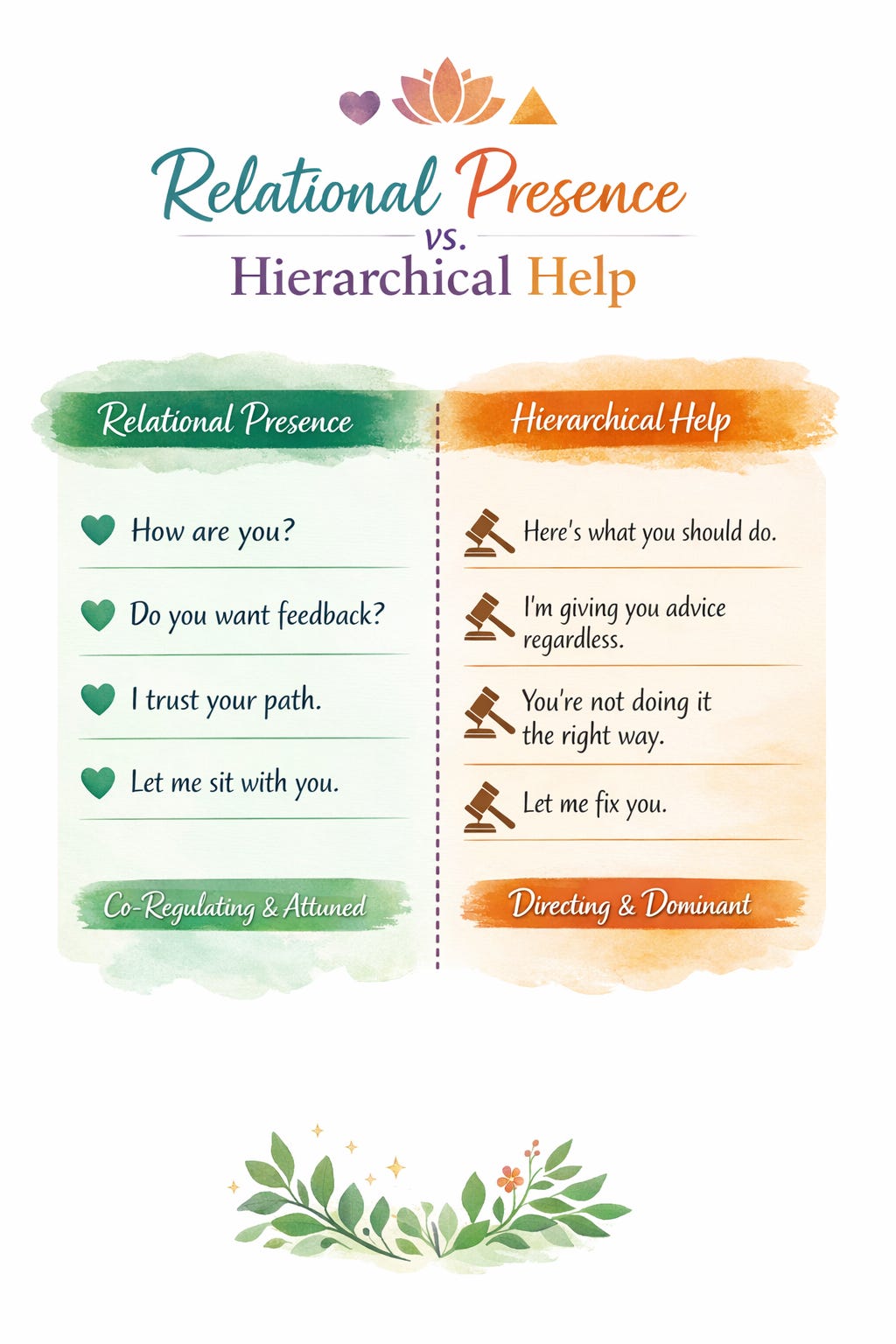
Relational Presence Is
• “What’s alive in you right now?”
• “Do you want feedback?”
• “I trust your timing.”
• “Let me sit with you.”
Relational Presence Is Not
• “Here’s what you should do.”
• “You’re doing it wrong.”
• Advice without consent.
• Fixing disguised as caring.
• Tough love or sermons administered like medicine.
Relational presence doesn’t control the moment.
It co-creates it.
In its most artistic form, it’s improv. Listening so well to your scene partner that what unfolds belongs to both of you.
If you’re a fan of late night TV, you see the hosts are masters of it. They have to simultaneously attune to: the audience, the guest, the last minute changes, and be present.
I’m a fan of Dean Martin and for years in my twenties I subscribed to the Dean Martin Variety Show DVDs from Guthy-Renker. He flowed with every mistake. He danced and sang with every guest, playfully in the moment. He even embraced every wrong note. He was one attuned dude.
I worked for comedian Garry Shandling in the early aughts, and Garry would say, “You have to get out of your head, and connect.”
Hierarchical Power Plays
Hierarchy uses tools to preserve itself.
Some are obvious: yelling, insult, removing access.
Others are subtle: controlling who gets credit, withholding information, destabilizing quietly.
When I worked in Hollywood as a development executive, a colleague of mine hid our screenplay log from me. Logging scripts was central to our role, and the company shared one log. (It’s how we knew what movies we passed on.) By locking me out, he ensured I would look incompetent. When confronted, he denied it.
Hierarchy sucks except to the one guy on top who gets the promotion.
Destabilize. Control. Separate. Dominate.
Hierarchy has a lot of cards up its sleeve. But it’s missing a few cues, too.
One of the clearest giveaways of hierarchy is the absence of curiosity.
Notice:
Do they ask about you?
Do they invite your perspective?
Do they seem interested in your reality? What if your reality is different than theirs?
Do they try to understand where you’re coming from?
Do they investigate your perspective, or flatten it, or worse… just let it reflect something about them?
My friend Doctor Neha has a phrase my son has heard a lot growing up, “Curious before furious.”
When your nervous system starts to freeze, spiral, clench, or fire, pause. The signal is information.
Sometimes what’s missing tells you more than what’s said.
Gaslighting and Control
We’re more familiar now with overt gaslighting these days than we were when I was growing up.
The term comes from the 1944 film Gaslight starring Ingrid Bergman and Charles Boyer, where a husband manipulates his wife into doubting her sanity, sending her down a dark spiral of confusion in order to control her.
Anytime someone tries to destabilize you, especially by making you doubt yourself, they’re trying to control you. That’s hierarchy. That’s not attunement.
Gaslighting can also be subtle:
• Reframing your experience without consent
• Skipping over your expressed clarity
• Assuming their interpretation outranks yours
• Ignoring your boundaries and replacing them with their narrative
When hierarchy and harm intersect, exiting is self-protection.
You can hang up. Drive away.
Leave the room. Go to the bathroom. Everyone has to go to the bathroom!
You can remove someone’s access to your nervous system by removing yourself.
If you ask for what you need and you get dismissed, you may want to reassess their capacity for relational presence.
Trust Your Nervous System
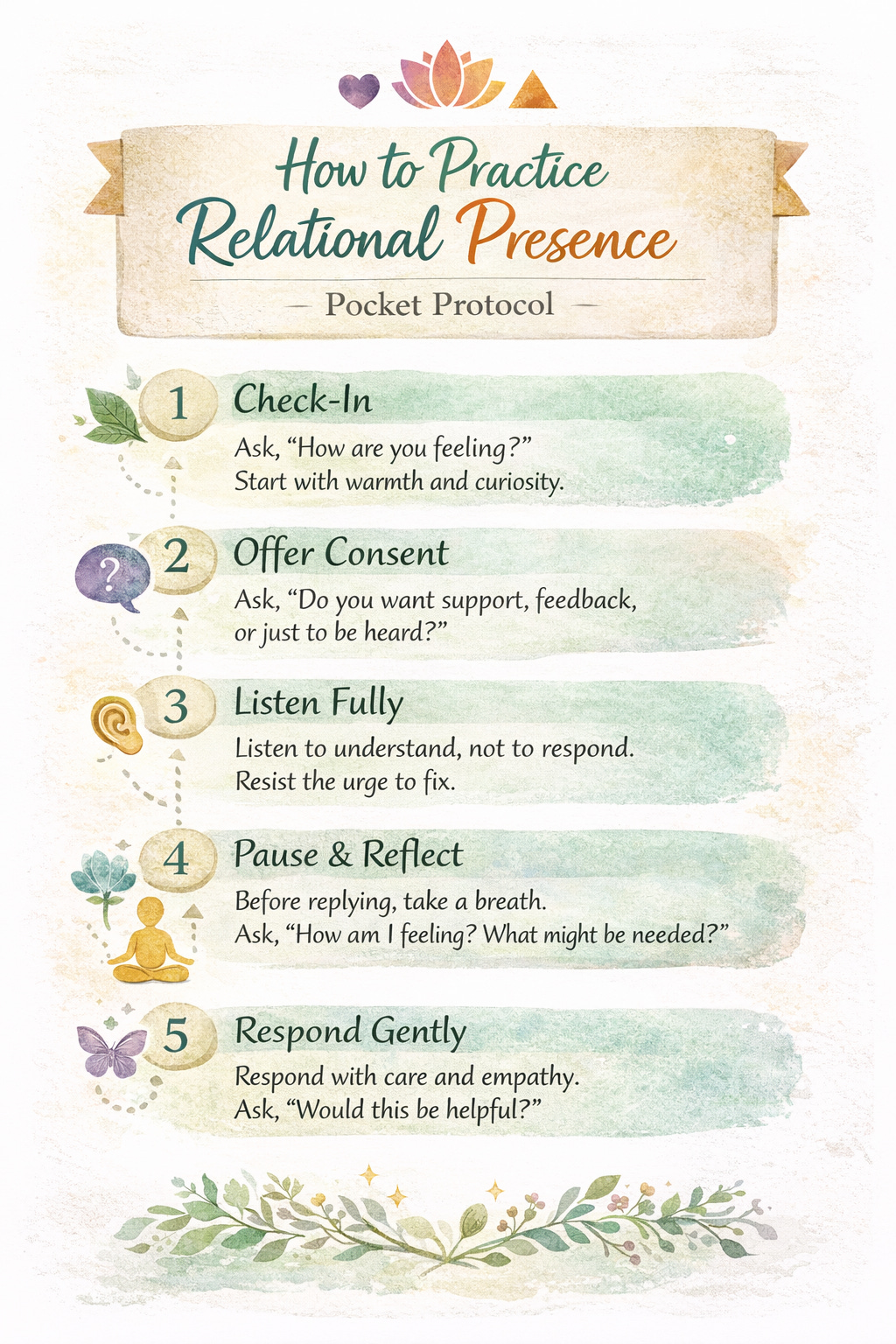
What would your relationships feel like if presence mattered more?
What if your nervous system could relax instead of bracing?
Who would you want to be closer to? And who would you step back from?
Relational presence is a re-patterning.
And it may be one of the most powerful forms of love we have.
Your nervous system is an ancient interface, one that evolved over millions of years to keep you safe and regulated. The more you attune to yourself, the more you’ll notice who is attuned to you.
Where every feeling has a friend.
💬 Leave a comment with your thoughts
🔁 Share this with your mood crew
👀 I read every reply
About the Creator:
Kaia Alexander (neé Van Zandt) is a mood cartographer, and creator of Mood O.S.™. She maps the world of feeling: in color.
She’s a UN speaker, award-winning author of Stealth Pitch, and a neuroqueer entrepreneur with expertise in stress response, and nervous system as the original interface. Her work bridges story and systems.
A former Hollywood development executive, she greenlit major motion pictures and later founded the Entertainment Business School.
Her work as a systems architect is now sparking a global Mood Renaissance.
She loves cats, tea, surfing… and cats that surf.
IP Protection Notice:
The concepts and terminology described in this post — including but not limited to Mood O.S.™, Mood Roundels, Mood Genome, Somaform, Obi the Mood Cat, and the emotional, mood, and nervous system interface architecture outlined here — are part of an original intellectual property system and design framework currently under trademark and patent protection by Kaia Alexander. Unauthorized reproduction or commercial use is strictly prohibited.